Turbidity describes how cloudy the water appears, while Total Suspended Solids (TSS) measures the actual concentration of particles suspended in the water. In aquaculture, these particles primarily consist of fish faeces, uneaten feed, biofilm fragments, microorganisms, and fine organic matter generated within the system.
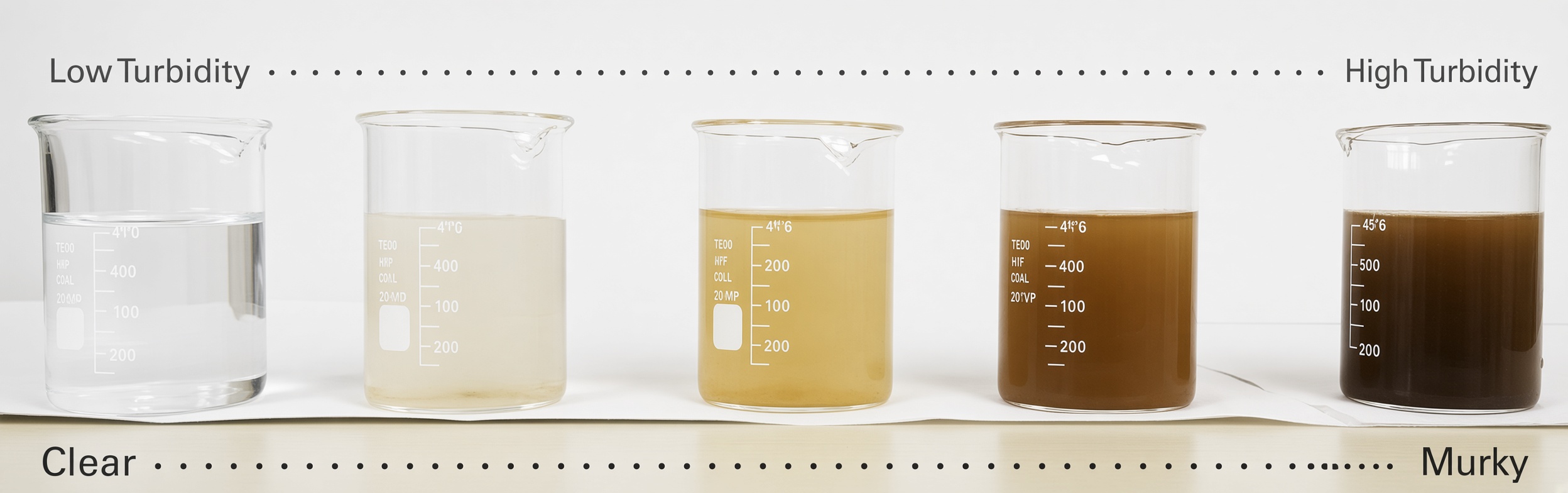
Excessive suspended solids can negatively affect fish health and system performance. Fine particles may irritate or clog the gills, increase physiological stress, reduce growth rates, and create favourable conditions for opportunistic pathogens. Suspended particles can also reduce water clarity, interfere with fish behaviour and feeding, decrease the effectiveness of UV disinfection by shielding microorganisms from ultraviolet light, and increase the biological oxygen demand as organic matter decomposes.
Solids management in RAS
In recirculating aquaculture systems (RAS), solids management is a critical design and operational consideration. The goal is to remove particles as quickly as possible after they are produced, before they break down into dissolved wastes that are more difficult to remove. Effective solids control typically relies on self-cleaning tank hydraulics, central drains, swirl separators, radial flow settlers, drum filters, microscreens, and regular sludge removal. Well-designed hydraulics help transport particles rapidly to treatment units while preventing accumulation in tanks and pipework.
Particle size is also important. Larger particles are generally easier to remove mechanically, whereas fine particles may remain suspended for long periods and require advanced filtration, foam fractionation, or polishing treatment. As particles break apart through pumping and recirculation, removal becomes increasingly difficult, making rapid solids capture a key objective in modern RAS design. See drum filters, sludge handling and the mass balance under dissolved oxygen (TSS per kg feed).
Key points
- Turbidity measures water clarity; TSS measures suspended particle concentration.
- Main sources are faeces, uneaten feed, biofilm, and organic debris.
- High TSS can damage gills, increase stress, and reduce growth.
- Suspended particles can shield bacteria and parasites from UV treatment.
- Organic solids consume oxygen as they decompose.
- Rapid removal improves water quality and biofilter performance.
- Good tank hydraulics and drum filtration are essential for intensive RAS.
Typical interpretation (orientation)
Values below refer to TSS in mg/L. Acceptable levels vary with species, life stage, system design and production intensity. Turbidity (e.g. NTU) often correlates with TSS but is not the same measurement - only compare values in the same unit. Orientation, not a permit value.
| TSS (mg/L) | General interpretation |
|---|---|
| < 5 | Excellent |
| 5–15 | Good |
| 15–30 | Acceptable |
| 30–50 | Elevated — monitor closely |
| > 50 | Poor solids control |
| > 100 | Likely to impact fish health and system performance |
Teaching orientation for intensive culture. Salmonids and hatcheries often aim toward the lower end. Always check against your standard and UV requirements (UVT).
Species comparison — who tolerates murky water?
Not all species are equally sensitive to solids. Salmonids (rainbow trout, salmon, Arctic char) are often "primadonnas": they want clear, oxygen-rich water and react early to gill irritation and stress. Carp are more robust in ponds. Catfish and mudfish (e.g. Clarias) cope better with murkier, organic-rich water. Shrimp sit in between — intensive tank/RAS prefer clearer water, while pond culture often runs murkier. Figures are teaching approximations for an upper preferred TSS (mg/L), not culture protocols.
| Species group | Approx. upper preferred TSS | Clarity preference | Comment |
|---|---|---|---|
| Salmonids (trout, salmon, char…) | ~10–15 mg/L | Very clear | Primadonnas — gills and stress-sensitive |
| Shrimp — intensive tank / RAS | ~20–30 mg/L | Clear | UV, visibility and gills benefit from low TSS |
| Shrimp — pond / semi-intensive | ~40–60 mg/L | Moderate–murky | Algae and clay common; manage oxygen and sediment |
| Carp | ~50–80 mg/L | Tolerates murk | Classic pond species; robust but not "dirty = good" |
| Catfish / mudfish (e.g. Clarias) | ~100–150 mg/L | Murky OK | Best murky/organic tolerance in this comparison |
Same linear thinking as the bar chart. Intensive RAS usually aims lower than ponds for the same species. Fry and hatchery tighter than grow-out.
TSS tolerance by species group (teaching orientation)
Approx. upper preferred (mg/L TSS)
Bars show an approximate upper preferred TSS (mg/L) for “good culture water”, same linear scale 0–150. Salmonids want clear water; carp tolerate more; catfish/mudfish and many pond shrimp cope with murkier water. Intensive RAS usually aims lower than ponds. Not a species protocol or permit value.
 © 2026 DABCE AB
Teaching point: design solids control for the species — a rainbow trout RAS needs fast, fine filtration; a Clarias pond can live with more murk if oxygen and gills stay under control. "Tolerates murky" does not mean ignore filters and UV when the system needs clear water.
Differences between systems
- RAS / semi-flow: solids are driven by filters and hydraulics; delayed removal means fines, lower UVT and more BOD.
- Flow-through / raceway: source turbidity + faeces; settling and screens before discharge.
- Ponds: algae, clay and sediment — turbidity can be natural but night-time oxygen risk and gill stress remain.
- Net pen: surrounding water dominates; algal blooms and sediment under the pen.
In short: remove particles early, whole and dry - before they become dissolved problems for gills, UV, oxygen and the biofilter. See drum filters, disc filters, sludge and UV.
Sources/overview (selection): Timmons & Ebeling, Recirculating Aquaculture Systems; Summerfelt, solids removal in freshwater RAS; FAO aquaculture engineering resources; Lekang, Aquaculture Engineering. Orientation - not species-specific limits or permits.