
Introduction
Low pH water is acidic water. On the pH scale, 7 is neutral. Values below 7 mean the water is acidic. In homes and buildings, the practical concern usually starts when pH falls below about 6.5.
Acidic water is not always unsafe to drink on its own. The bigger problem is what it does to pipes, taps, water heaters and fittings. It can dissolve metals from the installation and leave stains you can see. That is why plumbers and homeowners often notice the problem long before anyone talks about chemistry.
What pH actually tells you
Think of pH as a simple “how aggressive is this water?” number.
- Around 7 — balanced.
- 6.5–8.5 — the usual target range for drinking water in many countries.
- Below 6.5 — more likely to attack metal pipes and fittings.
- Below 6 — corrosion can become clearly visible within months.
- Below 5 — the water can damage copper and other metals quickly.
A small drop in pH is more important than it looks. The scale is not linear. Water at pH 5 is much more aggressive than water at pH 6.
pH is only one piece of the picture. How corrosive the water is also depends on alkalinity (the water’s ability to buffer itself), dissolved carbon dioxide, hardness, and how long water sits in the pipes. That is why a full water analysis is better than a single strip test — but a pH reading is still a very good first check.
How you notice it in a house
Typical signs:
- Blue-green stains in sinks, baths, showers and toilets
- Green or turquoise marks around taps and drain holes
- Metallic, bitter or “coin-like” taste
- Pitting or dull, worn metal on fittings
- Pinhole leaks in copper pipes
- Shorter life of water heaters, dishwashers and washing machines
- Worse taste and colour after the water has stood overnight
Blue-green staining is often copper from the pipes. The stain itself is not the main health issue. The concern is that the same water can also pick up other metals from old solder, brass fittings or older installations.
Plastic pipe (PEX, PE, PVC) does not corrode the same way. That is why two neighbouring houses can have the same well water and very different problems — one has copper, the other does not.
Why water becomes acidic
Low pH is common in private wells, especially where rainwater moves through soil and rock that do not contain much limestone.
Typical causes:
- Rain and soil naturally pick up carbon dioxide and weak organic acids
- Groundwater that never meets limestone or other buffering rock
- High dissolved carbon dioxide in the well
- Soft, low-mineral water with little alkalinity
- Some surface waters and forested catchments
- Occasional municipal supplies if the source is naturally acidic and not fully corrected
It is not usually “something you did wrong”. It is often the geology.
What it does to plumbing
Acidic water slowly dissolves metal from the inside of the system.
Copper pipes can thin, pit and eventually leak. Brass fittings can lose zinc. In older buildings, solder joints may contain lead. Water heaters and boilers can suffer on both the water side and the fittings.
Two practical points for installers:
- Fix the water before you replace the pipes. New copper in the same acidic water will start the same process again.
- Correct pH early in the treatment chain. Low pH keeps iron and manganese dissolved. If you try to filter iron first, the chemistry works against you. Raise pH first, then treat iron, manganese, hardness and disinfection as needed.
How to confirm it
Do this in order:
- Measure pH at the tap. A good test kit or a calibrated meter is better than a cheap strip, but a strip is enough to see if you are clearly below 6.5.
- Take a proper water analysis: pH, alkalinity, hardness, iron, manganese, copper, conductivity, and bacteria if it is a well. In older houses, consider lead as well.
- For metals from plumbing, a first-draw sample (water that has sat in the pipes overnight) is useful. Then take a flushed sample. If copper is high only in the first draw, the pipes are the source.
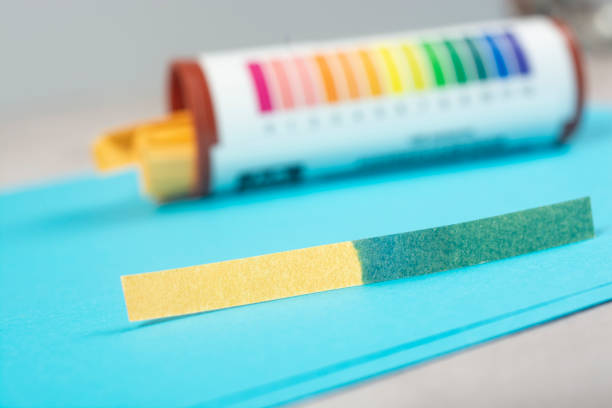
Do not guess the treatment from stains alone. Green stains usually point to copper and low pH, but iron, manganese and hardness often sit in the same water.
Remineralisation with CaCO₃
A simple way to raise low pH is to let the water pass through calcium carbonate (CaCO₃) — the same mineral as limestone or calcite.
A little of the stone dissolves. That does two useful things at once: it lifts the pH and it puts a small amount of calcium back into the water. The water becomes less aggressive toward copper pipes and fittings, and it is no longer as “empty” and sharp as very soft acidic water.
This is the idea behind a calcite neutraliser: crushed CaCO₃ in a tank on the incoming line. It is well suited to mildly or moderately acidic water. The media is slowly used up and needs topping up. The water may become a little harder — that is normal, and it is part of how the treatment works.
CaCO₃ remineralisation helps the plumbing and can make the water taste more natural. It does not replace a full analysis, and very low pH may still need a stronger method. For many homes and wells, though, calcite is the first and often sufficient step.
How low pH water is treated
The goal is simple: bring the water up into a stable range, usually around 7 to 8, before it enters the rest of the building.
1. Neutralising filter (most common in houses)
A tank filled with calcite (crushed limestone, calcium carbonate), sometimes mixed with a stronger magnesium media.
Water flows through the media. A little of the stone dissolves. pH and alkalinity rise.
- Works well for mildly to moderately acidic water (often about pH 5.5–6.5).
- No electricity in many designs.
- The media is used up and must be topped up.
- Water often becomes a little harder. That is expected.
- Needs enough contact time and the right tank size for the flow of the house.
If pH is only slightly low, calcite alone is often enough.
2. Stronger media mix
When pH is lower (around 5–6), calcite is often blended with magnesium oxide (sometimes sold as Corosex or similar). The mix raises pH more than calcite alone. It must be designed carefully so pH does not overshoot.
3. Chemical dosing (soda ash)
A small pump adds sodium carbonate (soda ash) into the water.
- Used when pH is very low (often below about 5–5.5), or when a filter cannot raise pH enough.
- Needs power, solution mixing, and regular checks.
- More of a professional installation and service job.
Baking soda (sodium bicarbonate) is a milder cousin of the same idea and is sometimes used in lighter applications.
4. Aeration / degassing
If the acidity comes largely from dissolved carbon dioxide, airing the water or letting CO₂ leave can raise pH without adding much hardness. This is more common on wells and in treatment plants than as a small under-sink unit.
5. Drinking-water point-of-use
A kitchen reverse-osmosis unit can improve drinking water, but it does not protect the pipes. Whole-house pH correction is what saves the installation.
Jug filters and ordinary carbon taps do not fix low pH.
Example treatment chains
Well
↓
Pressure tank
↓
Calcite neutraliser
↓
Rest of house
Optional: UV if bacteria are present.
Well
↓
pH correction
↓
Aeration or oxidation
↓
Iron/manganese filter
↓
UV
↓
Drinking water
Well
↓
Soda ash dosing (sometimes with a calcite tank after it)
↓
Other filters as needed
↓
House
Water analysis
↓
pH correction first
↓
Repair or replace damaged sections
↓
Normal operation
The exact order can change, but pH correction almost always comes early.
What to tell the customer
Keep it plain:
- The stains are a warning, not just a cleaning problem.
- The water is attacking metal from the inside.
- A neutraliser or a dosing pump treats the cause. Replacing taps treats only the symptom.
- After treatment, pH should be checked again. Media tanks need refilling. Dosing pumps need solution and service.
- Hardness may rise a little with calcite. That is the media doing its job.
Good practice for plumbers and installers
- Measure pH and note pipe material before you quote a “filter”.
- Size the neutraliser for peak flow, not only average use. Too small a tank means too little contact time.
- Leave space and valves for service and media refill.
- After start-up, check pH at a far tap, not only at the tank.
- Watch for over-correction. Very high pH can cause other problems.
- If the house is old, mention metals in first-draw water and recommend analysis, not only a pH strip.
- If you install plastic pipe in a low-pH property, you still may want pH correction for remaining metal parts: heater, mixer taps, valves, dishwasher.
Important to remember
Low pH is a water-quality and a plumbing problem at the same time. Correct the water, protect the installation, then deal with iron, bacteria or taste if they are also present.
A water analysis is the right starting point. Treatment should be chosen from the numbers, the pipe materials and how the building is used — not from the colour of the sink alone.
This page is general guidance for homeowners, plumbers and property managers. It is not a design for a specific site. Local drinking-water rules, pipe materials and well conditions decide the final solution.