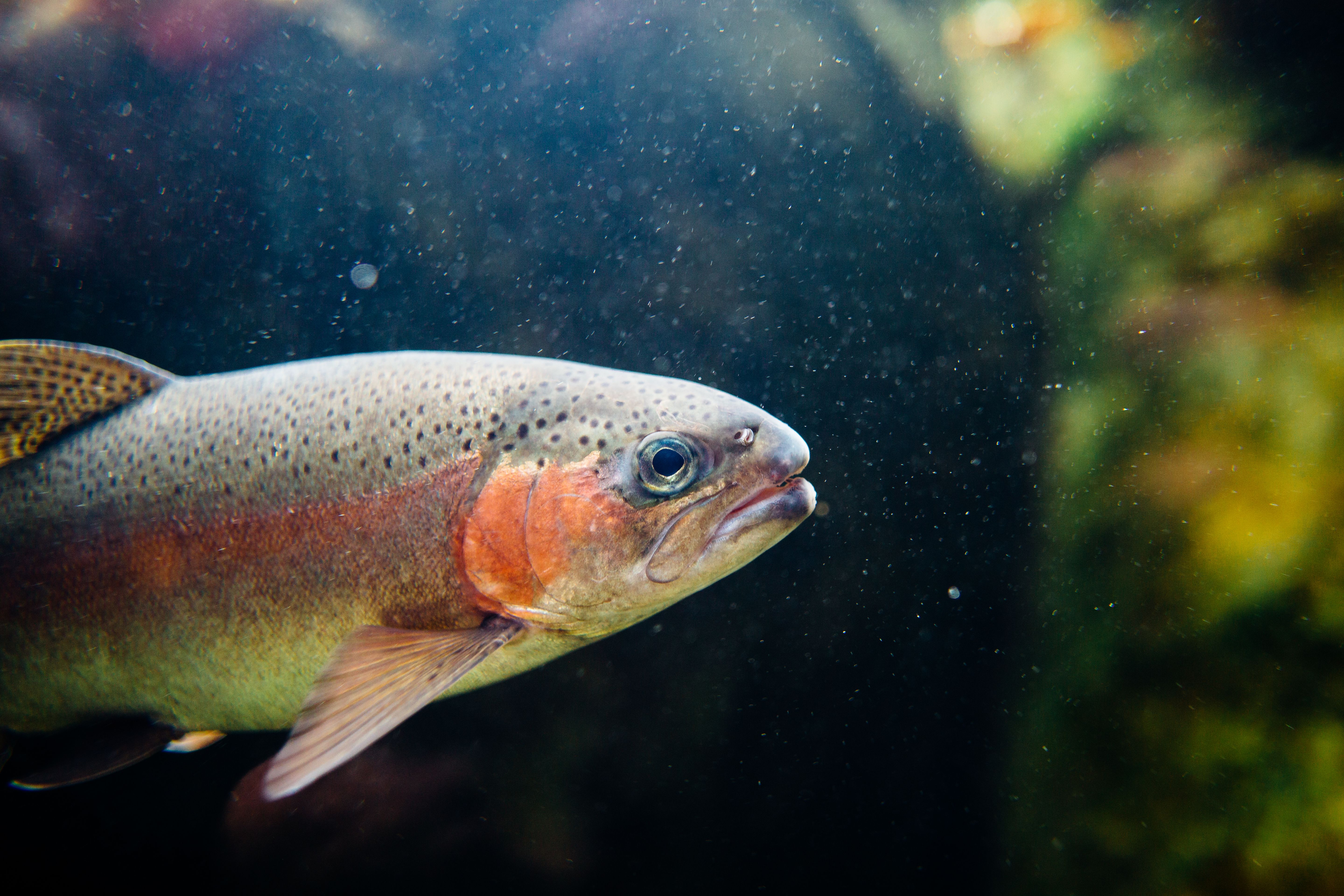
Arctic char (Salvelinus alpinus) is a cold-preferring salmonid with a circumpolar range in Arctic and sub-Arctic fresh waters - and in some stocks also in brackish water. In the Nordics it carries both cultural and commercial weight: wild and farmed char sell as premium fish, often at a higher price per kilo than rainbow trout, thanks to flavour, texture and a "Nordic" market profile.
Arctic char in aquaculture
Farmed Arctic char is a niche next to global salmonids, but it is strategically important in cold inland sites in Sweden, Finland, Iceland, Canada and Alaska. Production uses ponds and raceways with cold spring or lake water, cages in cold lakes, and increasingly land-based systems (semi-flow-through and RAS) where temperature can be held stable year-round.
Compared with rainbow trout, char grows more slowly at the same temperature and tolerates heat less well. Optimal growth often sits in the cooler range (roughly 8-14 °C depending on strain and life stage); above about 16-18 °C stress, reduced feed intake and health risks rise quickly. That makes the species more demanding in warm summers and more dependent on cold intake, shading, deep basins or active cooling in land-based farms.
Systems and technology
- Flow-through and raceways with cold spring or mountain water - classic inland solution where flow and temperature are enough.
- Cage culture in cold lakes - lower CAPEX but exposed to ice, under-ice oxygen risk, escapes and local environmental rules.
- Semi-flow-through / partial reuse - cuts freshwater use and discharge while keeping temperature control from the source.
- RAS with cooling - high control and biosecurity; energy for cooling and pumping becomes central to CAPEX/OPEX.
Water-quality demands are high: stable dissolved oxygen, low ammonia/nitrite, good solids control and gentle hydraulics. Char is sensitive to poor water chemistry and sudden swings - the same filtration, gas and monitoring principles as for other salmonids, but with even less temperature margin.
Market and economics
The premium position means better price but needs consistent quality, traceability and often limited volume. Longer production time and cooling needs raise cost per kg versus trout; profitability depends on differentiating the product (whole fish, fillet, smoking, local/Nordic branding) rather than only chasing lowest production cost. For project developers, char is therefore interesting where cold water is a natural advantage - and where the market pays for the niche.
Level production over the year
As with rainbow trout and Atlantic salmon, Arctic char spawning is seasonal if the broodstock environment is not controlled with light and temperature. A farm that wants to sell food fish every month — and fill RAS/semi-flow evenly — cannot rely on a single natural egg pulse. To level the biology you need either frozen milt / planned egg supply and delayed incubation, or control of the broodstock cycle (photoperiod and temperature, several brood groups out of phase), often combined. Otherwise hatchery and grow-out are sized for the peak season and sit partly empty the rest of the year. See Egg incubators (levelling biology over the year).
Typical production stages
- Broodstock
- Egg incubation (often cool, higher °D than trout)
- Fry / first feeding
- Fingerling
- Juvenile
- Food fish (often 0.8–2.5 kg depending on market)
Production timeline and growth (orientation)
Char grows more slowly than rainbow trout at the same temperature, but under good cool conditions (~10–12 °C) grow-out is much faster than an overly pessimistic cold-water curve. A useful orientation: about 9 months from ~20 g to ~900 g. Exact time depends on strain, temperature, feed and density — tables are typical ranges, not protocols.
| Stage | Size / weight | Typical duration |
|---|---|---|
| Egg incubation | Fertilised egg → hatch | ~2–3 months (higher °D, cool temp) |
| Alevin / yolk sac | Newly hatched | Weeks to swim-up |
| First-feeding fry | ~0.2–1 g | Weeks–months |
| Fingerling | ~5–50 g | Months |
| Juvenile | ~50–200 g | Months |
| Smaller food fish | ~0.5–0.9 kg | ~15–18 months from egg |
| Typical premium harvest | ~1–1.5 kg | ~18–22 months from egg |
| Large char | ~2–2.5+ kg | ~24–32 months from egg |
Ranges under favourable cool conditions. Heat, density and health lengthen the cycle. Orientation: ~9 months from 20 g to 900 g.
Example growth progression
| Time from fertilisation | Approximate size |
|---|---|
| Day 0 | Fertilised egg |
| ~2.5 months | Hatch |
| ~4 months | First feeding |
| ~6.5 months | ~5 g fingerling |
| ~8 months | ~20 g |
| ~12.5 months | ~150 g |
| ~17 months | ~900 g |
| ~19 months | ~1.2 kg |
| ~24 months | ~2 kg |
| ~30 months | ~2.5–3 kg |
Key interval: ~20 g → ~900 g in about 9 months under good cool conditions. Orientation.
- Rule of thumb: about 9 months from ~20 g to ~900 g
- About 15–18 months egg → ~0.5–0.9 kg
- About 18–22 months egg → ~1–1.5 kg (common premium)
- About 24–32 months egg → ~2–2.5 kg
- Keep temperature in the cool window — heat costs growth and welfare
Calculator: time-to-weight & production chain
Same tool family as for Atlantic salmon and rainbow trout, but with char’s slower growth curve (~8–14 °C) and typical harvest weights. Density, survival, tank classes, growth chart and layout generator included. Orientation — not bankable design.
Calculator: Arctic char — time-to-weight & production chain
1. Time from start to target weight
Approximate growth (orientation)
Curve follows char’s slower orientation data; tempo scales the x-axis. Logarithmic weight axis. Orientation — not a feed-control growth model.
2. Production chain toward annual target
H/W = water depth ÷ diameter (round) or flat–flat span (octagon). Optimal default 0.30 ≈ Ø:depth 3.3:1 (typical circular RAS tanks). Lower = flatter/larger footprint; higher = deeper/narrower.
Density (kg/m³) by fish size — adjust to strategy. More stages ⇒ shorter time per tank and sizing to exit weight ⇒ lower total volume.
Stages in the chain
| Stage | Weight (g) | Months | Fish in stage (avg) | Biomass (t) | kg/m³ | Volume (m³) |
|---|
Suggested tank plan
| Tank class | Stage | Days in tank | Unit volume | Depth | Area / tank | Diameter / span | Units | Class volume |
|---|
3. Layout generator (to scale, area = CAPEX) (Experimental)
Packing biased to the golden ratio (φ≈1.618): D+1.0 m cells, grid/shelf and a segment meta-grid so the hall is not one long thin strip.
Packing runs as JS in the browser (grid + shelf). Shared service D+1.0 m. Dashed circle = 0.5 m service zone. Orientation — not construction documentation.
 © 2026 DABCE AB
See also
- Temperature
- Dissolved oxygen
- RAS
- Flow-through
- Egg incubators
- Backup power systems
- Rainbow trout
- Atlantic salmon
Arctic char suits cold inland sites and land-based systems with temperature control. Sources/overview (selection): Nordic/Canadian practice for Salvelinus alpinus; Timmons & Ebeling and others. Growth figures are orientation — strain, temperature, feed and health govern real time. See also FlowFarm.