
Flow-through is the classic land-based farming model: fresh water is taken from a source (river, lake, spring or well), passed through culture units - often raceways, concrete channels, ponds or tanks - and returned to the receiving water after more or less treatment. Unlike full RAS, only a small share of the water is reused (or none at all); oxygen and water quality in the farm are driven mainly by the incoming flow and how long the water stays with the fish.
The principle is simple and robust. Where water rights, source quality and the receiving water allow, flow-through has long been the standard for e.g. rainbow trout, smolt and other salmonids in cool freshwater. The site does not need the heavy pumping, filtration and oxygen infrastructure of a high-reuse RAS. The trade-off is high freshwater use, and nutrient, solids and sometimes pathogen discharges that must fit permits and the capacity of the receiving water.
In many parts of the world where aquaculture has grown faster than environmental regulation, this has led to significant local and regional environmental challenges. Eutrophication, oxygen depletion, sediment impacts and competition for water resources are examples of effects observed around intensive production areas. In water-stressed regions, large abstractions can also reduce water available to downstream users, agriculture and natural ecosystems.
As water becomes an ever more valuable resource and environmental requirements tighten, interest grows in technologies that cut both water use and discharges. This is a major driver behind modern RAS facilities and other high-reuse concepts. By treating and reusing water, production can be decoupled from large abstractions while nutrients and organic matter can be collected and treated in a more controlled way.
Typical water flow
Water source
(river / lake / spring / well)
↓
Intake & coarse screening
(screens, trash racks, sometimes settling)
↓
Culture units
(raceways / tanks / ponds)
↓
Limited treatment
(settling, solids removal,
sometimes biofilter / polish)
↓
Discharge to receiving water
+
Optional partial return pumping
(semi-flow-through / PRAS)
What drives the design?
Sizing starts from biomass, feed load and the water quality you need in the tank - above all dissolved oxygen, temperature, ammonia/TAN and solids. In pure flow-through, flow is the main lever: more water means more oxygen and more dilution of waste. That makes the farm sensitive to source flow, temperature and seasonal variation. In drought, ice runs or heat waves, capacity can fall quickly unless there is buffer volume, oxygen addition or scope to cut feed and biomass.
- Water rights and permitted abstraction from the source.
- Source quality: temperature, oxygen, turbidity, pathogens, seasonal swings.
- Receiving-water permits and capacity for nutrients and solids.
- Topography: gravity feed cuts energy cost a lot.
- Species and density - salmonids in raceways are most common in cool regions.
Advantages
- Low energy cost for recirculation - often gravity and simple intake/outlet.
- Simple, proven technology with lower CAPEX than full RAS.
- Good robustness where the source is stable and the receiver can take the load.
- Natural temperature and mineral profile from the source (pro or con depending on species).
- Simpler operation than tightly controlled closed loops - fewer critical process steps.
Limitations and risks
- High freshwater use per tonne of fish versus RAS.
- Nutrient (N, P) and solids discharge must be sized against permits and the receiver.
- Limited independence from the environment - drought, heat, ice, turbidity and source pathogens hit the farm directly.
- Lower biosecurity than closed land-based systems if intake protection is weak.
- Growth and density are often limited by available flow rather than by technology ceilings.
Treatment before discharge
Even "simple" flow-through often needs solids removal and sometimes nutrient reduction under modern permits. Common steps are settling basins, microscreens, sludge thickening and in some cases biofilters or wetlands on the effluent. The tighter the permit and the more sensitive the receiver, the more the farm looks like semi-flow-through: more treatment, more reuse, more control - but still with a clear make-up stream from nature.
From pure flow-through to semi-flow-through
Many farms sit on a spectrum. Pure flow-through: almost all water passes once. Partial reuse (PRAS) / semi-flow-through: part of the flow is treated and returned, while a make-up stream brings in fresh water and a matching stream goes to the receiver after polish. That cuts freshwater need and discharge load without the extreme reuse rate and energy profile of full RAS. Raceways, hatcheries and inland salmonid farms often use that kind of hybrid.
The FlowFarm concept (DABCE™)
The DABCE FlowFarm concept is built on the same core principle: produce more fish with less water, better control of resource flows and significantly lower impact on surrounding aquatic environments. The more efficiently water, oxygen, energy and nutrients are recirculated, the closer the facility comes to a truly circular production system. ♻️
DABCE FlowFarm™ is a real, buildable semi-flow-through concept: water is taken in (e.g. via subsea pump and pipeline), protected with a bio-barrier and coarse filtration/UV, aerated, passed through fish units, then sludge separation and an integrated biostage/particle filter suited to Nordic conditions (e.g. DynaSand), with controllable recirculation back to culture and a return pipeline to the receiving water. Intake, culture, treatment, sludge and return form one coherent system - without the heavy up-front investment that full RAS often requires.
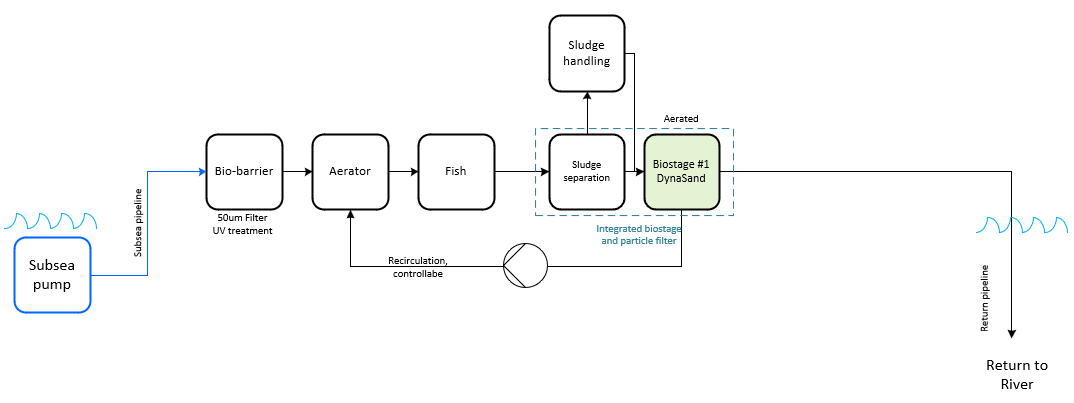
The schematic includes, among other things: subsea pump and intake pipeline; bio-barrier with 50 µm filter and UV; aerator; fish units; sludge separation with separate sludge handling; integrated biostage and particle filter; controllable recirculation pump; return pipeline back to the river. These are the same building blocks as in many modern inland systems, arranged as a clear process chain.
The FlowFarm facility is DABCE's real farming concept - a Swedish "lagom" path toward more sustainable production. The FlowFarm modelling tool, by contrast, is for modelling, comparing and understanding (CAPEX/OPEX, flow, oxygen, treatment) in early stages: feel free to test scenarios, but final design and bankable engineering need more detailed analysis and professional design work.
See also the sections on RAS, raceways, hybrid systems and water quality.