
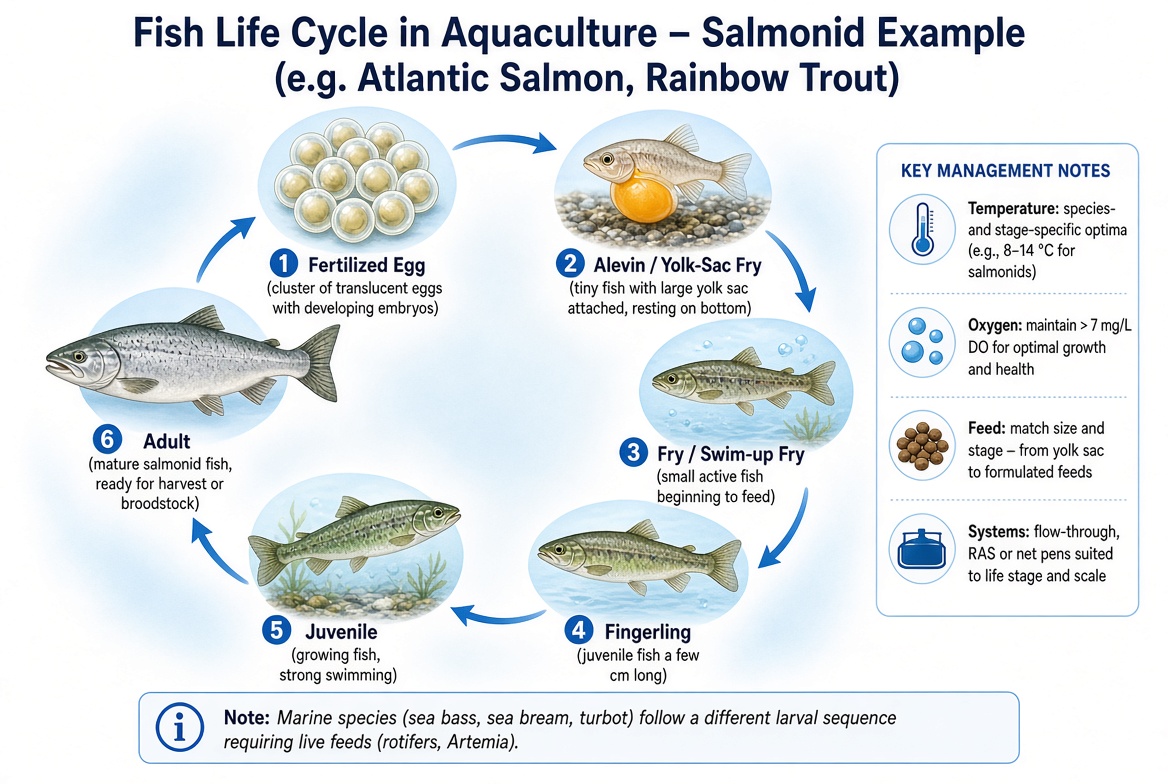
Understanding the fish life cycle is fundamental in aquaculture because each stage has different requirements for water quality, feeding, tank design and management. Hatcheries, nurseries and grow-out systems are often designed around these biological milestones.
Quick reference: critical differences between stages
| Stage | Temp / oxygen | Feeding | Handling |
|---|---|---|---|
| Egg | Stable temp; high DO; gentle flow | None | Gentle; disinfection; remove dead eggs |
| Alevin | Critical temp & DO | Yolk sac (no external) | Very sensitive — minimise disturbance |
| Fry | Stable WQ; high DO | First feed; correct particle size | Sensitive; frequent checks |
| Fingerling | DO & density matter | Commercial feed | Transport/stocking possible |
| Juvenile | Peak O₂ & biofilter load | High ration; FCR focus | Grading; density control |
| Adult | Species-dependent targets | Maintenance / brood feed | Harvest or broodstock regime |
Orientation — species, system and life stage govern details. See temperature, dissolved oxygen, egg disinfection and fry tanks.
Egg
The life cycle begins with the fertilised egg. During incubation, temperature, oxygen and water flow are carefully controlled to maximise survival and minimise fungal growth.
Common management practices include:
- Disinfection of eggs before incubation.
- Removal of dead eggs to prevent fungal spread.
- Monitoring temperature to control development rate.
- Maintaining stable oxygen levels and gentle water flow.
In salmonids, the eyed-egg stage is a major milestone — eggs can often be transported more safely after reaching this stage. See also egg incubators and egg disinfection.
Alevin (yolk-sac fry)
After hatching, the larvae are known as alevins in salmonids. At this stage they often remain on the bottom and rely entirely on their internal yolk sac for nutrition.
- No external feeding required.
- Limited swimming activity.
- High sensitivity to handling and stress.
- Oxygen and temperature remain critical.
The duration of the yolk-sac stage varies greatly between species and temperature conditions.
Fry
When the yolk sac is absorbed, the fish swim actively and begin feeding externally. This stage is known as fry or swim-up fry.
Critical factors include:
- Successful transition to external feed.
- Feed particle size matched to mouth size.
- Appropriate light levels.
- Frequent feeding schedules.
- Careful monitoring of water quality.
The first-feeding period is often one of the most critical bottlenecks in hatchery production. See fry and larval tanks.
Fingerling
Fingerlings are juvenile fish large enough for transfer to nursery systems, ongrowing tanks or stocking programmes.
- Fully weaned onto commercial feed.
- Strong swimming ability.
- Improved disease resistance.
- Suitable for transport and stocking.
Fingerling size varies by species but commonly ranges from a few grams up to about 50–100 g.
Juvenile
The juvenile stage is generally the fastest growth phase in commercial aquaculture. Management focuses on maximising growth rate, maintaining low FCR, controlling stocking density, providing sufficient oxygenation and managing biofilter loading. Most feed consumption and biomass production occur during this stage.
Adult
Adult fish may be harvested as food fish or retained as broodstock for reproduction. Food-fish production typically targets market size, product quality, fillet yield and appearance. Broodstock management focuses on reproductive performance, egg quality and genetics.
Species-specific life cycle variations
Salmon
Atlantic salmon (Salmo salar) have a unique life cycle involving migration between freshwater and seawater. Typical sequence: egg → alevin → fry → parr → smolt → post-smolt → adult. During smoltification the fish undergo physiological changes that prepare them for seawater — one of the most important phases in salmon production. See Atlantic salmon.
Trout
Rainbow trout (Oncorhynchus mykiss) follow a similar early life cycle to salmon but are often raised entirely in freshwater or low-salinity brackish water. Typical sequence: egg → alevin → fry → fingerling → juvenile → adult. No seawater transfer is required in most commercial production systems. See rainbow trout.
Marine species (sea bass, sea bream, turbot, etc.)
Marine fish often have a more complex larval stage than salmonids and generally require live feed. Typical sequence: egg → larva → post-larva → juvenile → adult. First feeding often depends on rotifers, Artemia, microalgae and progressive weaning onto dry feed. Larval rearing is often the most technically demanding and expensive phase. See sea bass and turbot.
Why the life cycle matters in aquaculture
Every life stage requires different infrastructure, water quality targets and management practices. A modern hatchery may contain separate systems for egg incubation, fry rearing, nursery production and broodstock management. Understanding the fish life cycle helps operators optimise growth, survival, biosecurity and production economics throughout the entire farming process.
See also