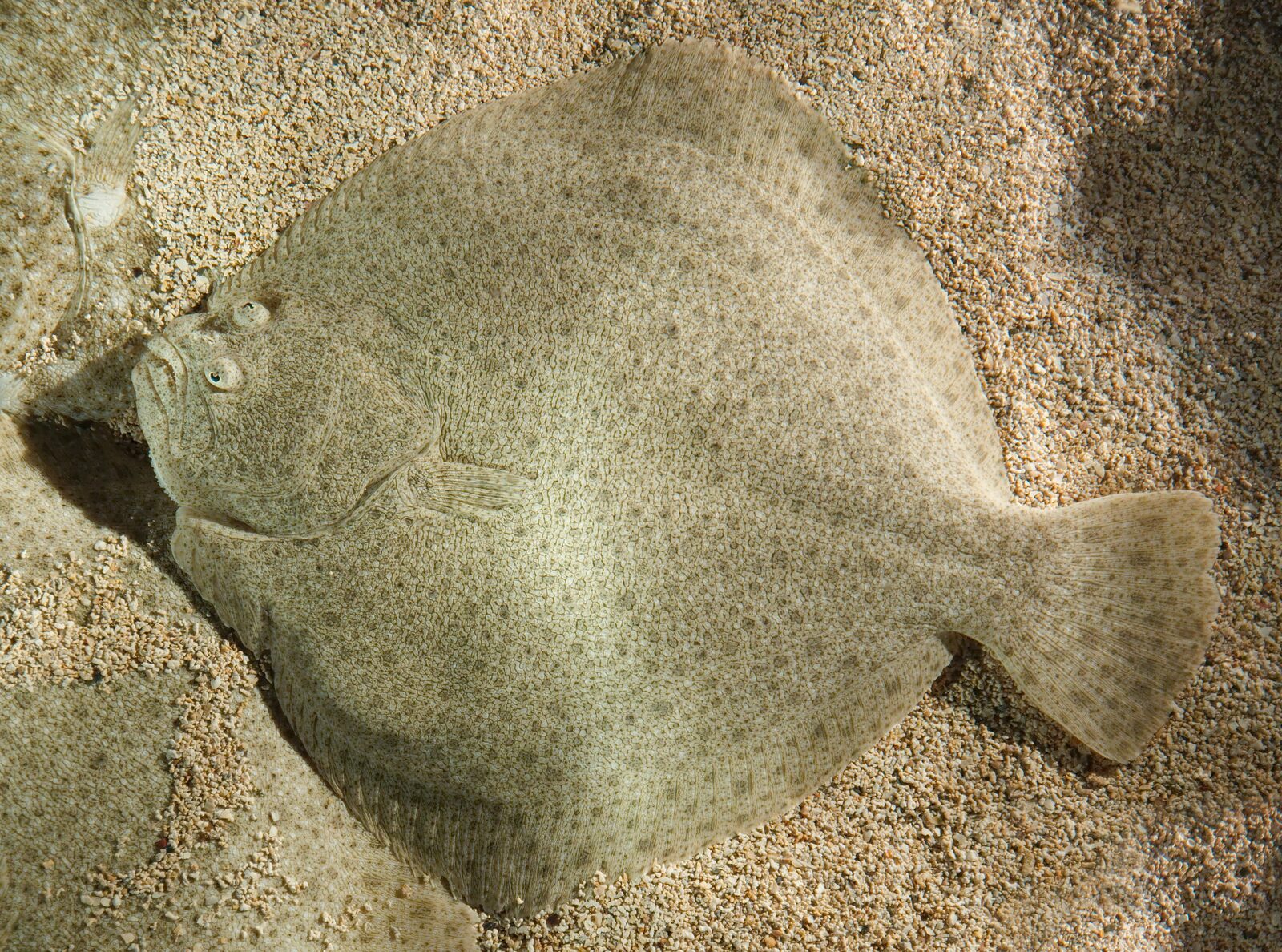
Turbot (Scophthalmus maximus) is a high-value marine flatfish naturally found in the Northeast Atlantic, the Baltic Sea and the North Sea. It is well known in gastronomy and valued for firm white flesh and a high market price. Commercial farming takes place mainly in Europe, using both coastal flow-through systems and modern land-based recirculating aquaculture systems (RAS).
Turbot suits land-based culture because it lives on the bottom and can be held at relatively high biomass densities in shallow tanks. Its flat body shape means tank bottom area is often more important than tank volume when sizing the system. Good water quality, stable temperature and high dissolved oxygen are decisive for optimal growth and fish health.
Fry and larval phase – the main bottleneck
The greatest challenge in turbot farming is larval production. Larvae are very small and need advanced rearing with live feeds such as rotifers and Artemia before weaning onto dry feed. Metamorphosis from a symmetrical larva to a flatfish, with one eye migrating to the opposite side of the head, is a biologically complex process sensitive to nutritional deficiencies and culture conditions. The larval and fry phase therefore needs high competence and specialised equipment.
As with many marine fish species, larval production is the most technically demanding part of the chain. Commercial success often depends on the ability to produce large volumes of robust fingerlings of even quality. Many commercial producers therefore buy juveniles from specialised hatcheries instead of running full-scale reproduction and larval rearing themselves. For new projects, access to high-quality juveniles is often a more important success factor than the grow-out technology itself.
Typical production strategies
- Hatchery: eggs → larva (live feed, weaning).
- Nursery: larva/fry → juveniles after metamorphosis.
- Grow-out: juveniles → market size in shallow tanks (flow-through or RAS).
- Alternative model: buy juveniles and focus on grow-out.
Typical culture conditions
| Parameter | Typical range |
|---|---|
| Water | Seawater or brackish water |
| Temperature | 14–20 °C |
| Dissolved oxygen (DO) | High and stable |
| Tank type | Shallow round or rectangular tanks with large bottom area |
| Density (orientation) | Often tens of kg/m² bottom area (size-dependent) |
| Systems | Flow-through or RAS |
| Harvest weight | 1–3 kg |
Values are general guidelines. Actual performance depends on strain, feed, salinity, temperature, water quality and production strategy.
Growth and market size
Turbot is usually sold at weights between 1 and 3 kg depending on market. Growth time varies with temperature, feeding and production strategy, but production to market size normally takes several years and needs long-term planning of facility capacity. The production sizer below counts from stocking (juveniles) to harvest and sizes mainly bottom area (kg/m²), not volume as for roundfish.
| Stage | Size / note |
|---|---|
| Larva / first feed | Very small; live feed |
| Metamorphosis | Sensitive phase; eye migration |
| Juvenile / stocking | Grams–tens of grams (supplier-dependent) |
| Grow-out | Months–years in shallow tanks |
| Market fish | 1–3 kg |
Long cycle → fewer cycles per year and more standing biomass per tonne of annual production than in fast-growing warm-water species.
Advantages
- Very high market value.
- Premium product in restaurant and export markets.
- Suitable for land-based culture.
- Relatively good feed conversion under optimal conditions.
- Benthic species that uses shallow tank area efficiently.
Challenges
- Complex and costly larval production.
- High competence required in hatchery and nursery.
- Sensitive metamorphosis during early development.
- Marine culture requires management of salinity and corrosion.
- Access to juveniles can limit expansion.
- Long grow-out cycle needs long-term capital and capacity planning.
Market
Turbot is an established premium species in European gastronomy and export. Farmed turbot complements limited wild catch and can be delivered more evenly through the year from land-based facilities. A high price per kilo must be weighed against the long cycle, marine infrastructure and juvenile supply.
Production sizer (land-based, bottom area)
The turbot production sizer estimates fish numbers, standing biomass and required tank bottom area (m²) from target production, harvest weight, cycle time, survival and density in kg/m². Optional water depth gives an orientation tank volume. The tool is an orientation calculation for concept development — not detailed facility design.
Production sizer: turbot (orientation, bottom area)
 © 2026 DABCE AB
See also
Sources/overview (selection): European turbot culture (flow-through and RAS); Person-Le Ruyet et al. on growth and density; FAO and industry overviews on Scophthalmus maximus; studies on bottom-area density (kg/m²). Density, cycle time and other figures are orientation — strain, temperature, salinity and juvenile quality govern real production.