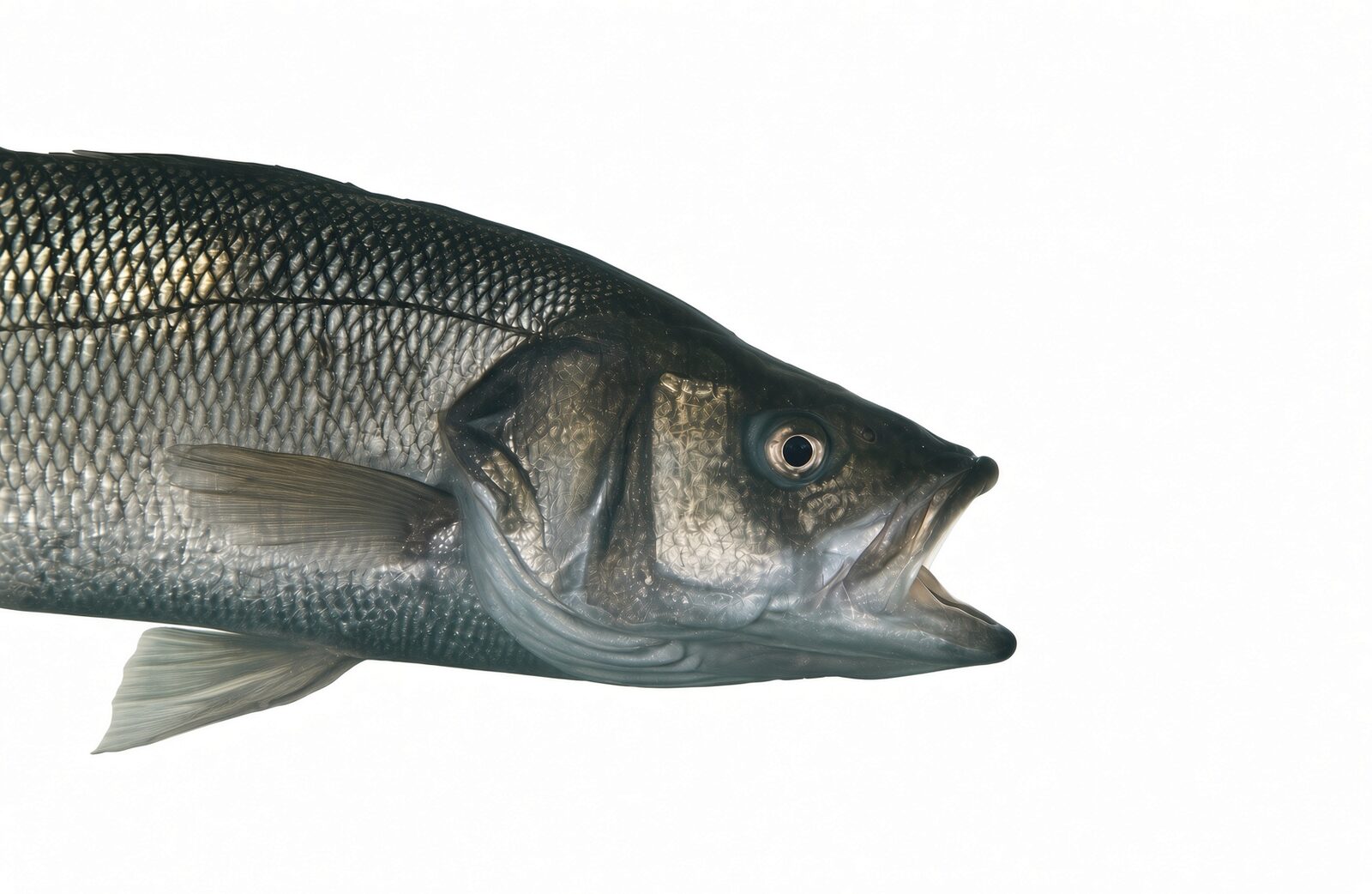
European sea bass (Dicentrarchus labrax) is one of the Mediterranean’s most important farmed fish species and has for decades been a cornerstone of European marine aquaculture. It is farmed mainly in Greece, Turkey, Spain, Italy and Croatia, traditionally in sea cages but increasingly also in land-based recirculating systems (RAS). High market demand, established feed programmes and good adaptability make sea bass an attractive species for modern mariculture.
Biology and distribution
Sea bass occurs naturally along Europe’s Atlantic coast and in the Mediterranean and Black Sea. It is a predator that feeds on smaller fish, crustaceans and other marine organisms. The fish is euryhaline and can tolerate large salinity variation, so it can be farmed in both marine and brackish waters.
Temperature
| Parameter | Typical range |
|---|---|
| Optimal | 20–26 °C |
| Acceptable | 12–30 °C |
| Growth declines | Clearly below about 15 °C |
| Stress risk | Prolonged above about 30 °C |
In northern Europe heating is often needed for maximum growth in land-based farms. Orientation.
Salinity
- Optimal salinity often about 25–40 ppt.
- Can be farmed in brackish water.
- Tolerates short-term variation better than many marine species.
- High tolerance gives flexibility when choosing a water source for RAS.
Oxygen demand
- Desired DO: >6 mg/L.
- Critical levels: <4 mg/L.
- High biomass needs effective oxygenation.
- Too-low oxygen → reduced appetite, slower growth and higher disease sensitivity.
Culture systems
Sea cages
The most common production form globally. Advantages: low capital cost, natural water exchange and proven technology. Disadvantages: exposure to disease and parasites, risk of storm damage and escapes, and limited control of environmental conditions.
Land-based RAS
Land-based sea bass production is growing. Advantages: full control of temperature and water quality, high biosecurity, less environmental impact on coastal waters and production closer to consumer markets. Disadvantages: higher capital cost, higher energy use and more advanced operation.
Growth
Sea bass has a moderate growth rate compared with many salmonids. Growth is strongly affected by temperature and feeding strategy.
| Stage | Typical time |
|---|---|
| Larva → about 2 g | 2–3 månader |
| 2 g → about 100 g | 5–7 månader |
| 100 g → 400–500 g market weight | 10–16 månader |
| Total production cycle | About 18–24 months |
Orientation under favourable conditions. The production sizer counts from stocking (juvenile) to harvest.
Typical growth curve (orientation)
Solid line = typical growth. Grey dotted lines = faster (earlier + higher weight) and slower (later + lower weight) — bands diverge over time. Log weight axis. Orientation — not a feed-control model.
Feed and FCR
- Carnivorous species; high-energy pellets.
- Protein typically about 40–50%; fat about 15–25%.
- FCR often about 1.2–1.8.
- Modern feeds increase the share of plant ingredients, algae and alternative marine raw materials.
Larval rearing and fry production
The most technically advanced part is often the hatchery and fry phase: egg incubation, larval rearing with live feeds (rotifers, Artemia) and gradual weaning onto dry feed. Fry production is today well developed and commercially established across much of the Mediterranean — many grow-out projects therefore buy juveniles.
Health and biosecurity
- Bacterial infections.
- Parasites.
- Stress-related problems.
- Water-quality-related disease.
RAS is increasingly used to reduce infection risk and improve control of the production environment.
Market and economics
Sea bass is an established premium fish on the European market and appears in restaurants, fish counters and retail. The product is sold mainly as whole fresh fish, boneless fillets and chilled premium products. The market benefits from high consumer acceptance, established logistics, stable demand in Europe and good willingness to pay for fresh products.
Key sizing parameters
- Annual production (t/year), market weight (g), biomass density (kg/m³).
- Daily feed, temperature, salinity, DO.
- TAN, nitrite, nitrate, CO₂, pH and alkalinity.
- UV or ozone dosing; heat and energy demand.
Sea bass is today regarded as one of the most mature marine species for land-based culture. Strong market demand, well-established fry production and relatively well-known culture parameters make it one of the leading candidates for marine RAS production in Europe.
Production sizer (RAS / grow-out)
The production sizer estimates fish numbers, standing biomass and tank volume from target production, harvest weight, cycle time from stocking, survival and density (kg/m³). Presets are grow-out-oriented (juvenile → market). Orientation for concept development — not bankable facility design.
Production sizer: sea bass (orientation)
 © 2026 DABCE AB
See also
Sources/overview (selection): European Mediterranean culture of Dicentrarchus labrax (cages and RAS); FAO and industry statistics; established feed and fry practice in Greece, Turkey, Spain and others. Density, cycle time and FCR are orientation — strain, temperature, salinity and health govern real production.