
Ponds are one of the oldest and still most important production forms in aquaculture. Despite growing attention on RAS and high-tech land-based systems, a very large share of world aquaculture production still takes place in various pond types - especially in Asia, Africa and Latin America.
From satellite imagery, some regions show vast areas covered by aquaculture ponds. Along coasts and river deltas in e.g. India, Bangladesh, Vietnam, Thailand, Indonesia, China and Ecuador, pond systems sometimes form continuous landscapes over tens or hundreds of square kilometres. In several of these areas, pond culture is among the dominant food industries.

Construction
Ponds are built in many ways depending on climate, soil, materials and production goals:
- Earthen ponds and clay ponds - embanked land where water is held by soil or clay dikes.
- Lined ponds (HDPE or other geomembranes) - cut seepage, ease cleaning and improve control.
- Concrete ponds - more permanent, higher CAPEX, easier to drain and disinfect.
- Partly lined ponds with earthen dikes, or natural ponds with reinforced banks.
The simplest ponds are embanked land with earthen dikes. In more intensive production, plastic liners are often used to reduce seepage and sediment issues and stabilise water quality. Area per pond can range from a few hundred square metres to several hectares; depth is often about 0.8-2.5 m depending on species, climate and strategy.
Global importance and species
Pond culture is used for a very wide group of organisms. In freshwater, common examples include carp (common, grass, silver, bighead), tilapia, pangasius, Clarias catfish, channel catfish, sturgeon, gourami, tambaqui/pacu and regional freshwater species. In brackish and marine water, mullet, milkfish, barramundi and in some cases sea bass/seabream are grown in lagoon- or pond-like units. Shellfish in ponds is globally huge: whiteleg shrimp (Litopenaeus vannamei), black tiger (Penaeus monodon), other penaeids and freshwater prawns (Macrobrachium). Add crabs, sea cucumbers, algae/macroalgae and shallow lagoon culture of mussels/oysters in some systems.
In Europe, ponds are often associated with carp culture, sturgeon for meat/caviar, recreational fisheries and more extensive freshwater farming. In Asia, by contrast, pond culture is the backbone of the aquaculture sector and accounts for enormous volumes of world fish and shellfish production.
Shrimp and "mud ponds"
When many people think of aquaculture they picture salmon cages or modern RAS. Globally, however, the classic shrimp pond is among the most widespread intensive production forms. A large share of the world's farmed penaeid shrimp is still produced in earthen / mud ponds, especially in India, Vietnam, Thailand, Indonesia, Bangladesh, China and Ecuador. Ponds can be several hectares; whole coastal landscapes in parts of Southeast Asia and Latin America are dominated by shrimp culture.
Aeration and oxygenation
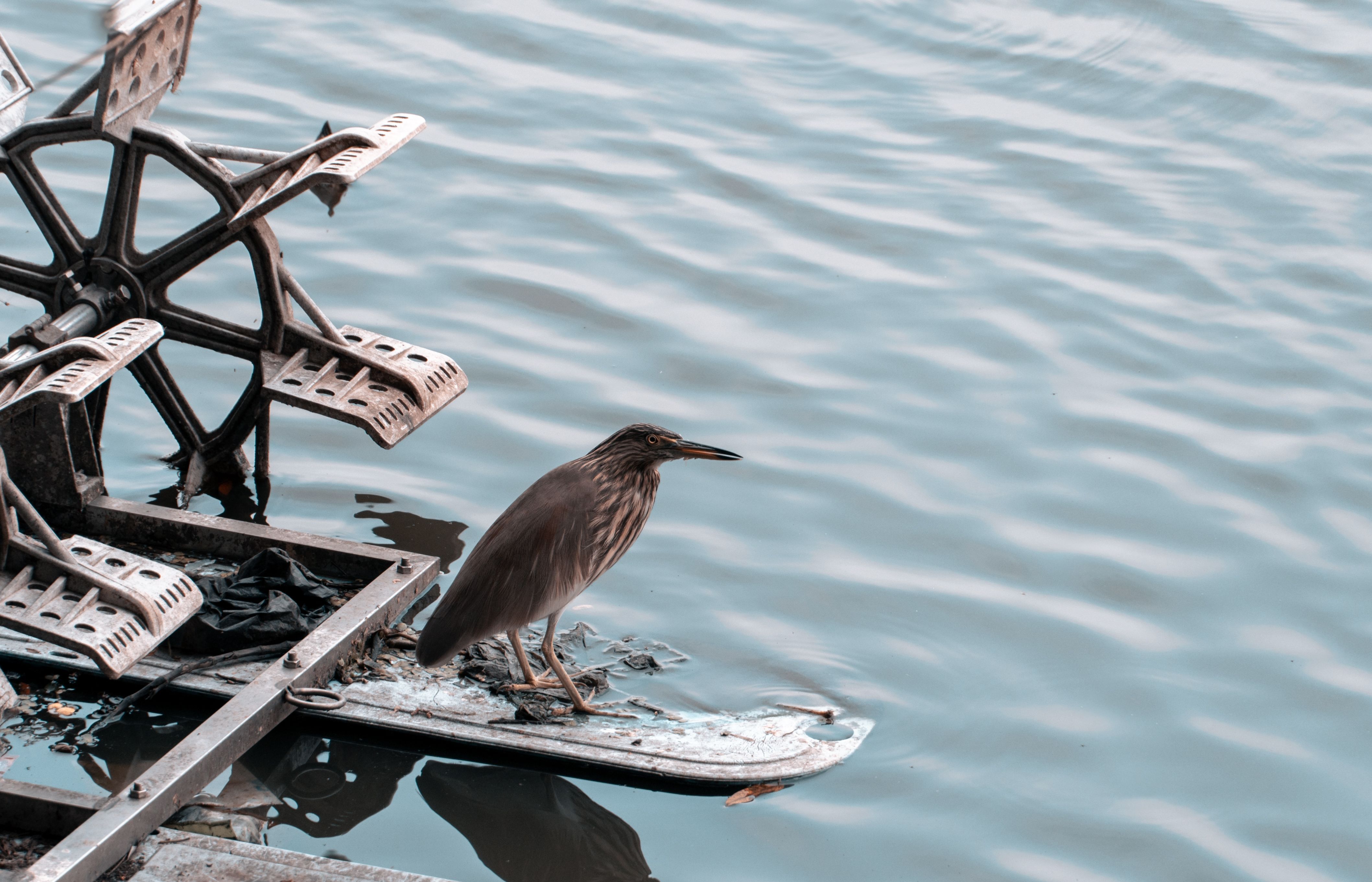
In extensive ponds, photosynthesis and moderate water exchange can supply enough oxygen. In intensive production, mechanical aeration is almost always used. The most iconic technology is the paddlewheel aerator - floating units with rotating paddles that throw water into the air.
- Add oxygen and drive circulation in the pond.
- Reduce low-oxygen zones and break temperature/oxygen stratification.
- Help move sludge toward collection areas and even out water quality.
On modern shrimp farms, long rows of paddlewheels may run around the clock during the cycle. Other common techniques: diffusers, aspirators, propeller aerators, fountain aerators, pure oxygen injection, and micro- and nanobubble systems on more advanced sites.
Natural productivity
One of pond culture's strengths is that the pond acts as an ecosystem. Besides added feed, it often produces phytoplankton, algae, zooplankton, bacteria, benthos and biofilms. Many species - especially carp, tilapia and shrimp - can use part of that natural production. Pond systems can therefore yield large biomass with relatively low technical complexity, provided nutrient balance, oxygen and sediment are managed.
Advantages
- Low investment cost (CAPEX) per area compared with tanks/RAS.
- Simple, robust technology with a large global experience base.
- Natural biological production that can complement feed.
- Suitable for many species and easy to scale to large areas.
- Often lower energy use than intensive closed land-based loops (depending on aeration and pumping).
Limitations
- Limited control of temperature and day-night oxygen swings.
- High water use and exchange in many systems.
- Exposure to weather, rain, drought and climate variation.
- Harder biosecurity than closed systems - risk of disease, predators and escapes.
- Algal blooms, night-time oxygen crashes and sediment build-up.
- Nutrient leakage to the surroundings can be substantial without treatment and good operation.
Development and place in the puzzle
Where water is scarce or environmental rules tighten, there is a gradual shift toward more controlled solutions: biofloc, partial reuse, hybrid facilities, lined ponds with stronger aeration and in some cases links to land-based treatment. Ponds can also be one step in a production chain - e.g. juveniles in more controlled units then grow-out in ponds, or the reverse - together with raceways, cages and RAS. See also design considerations under Raceways.
At the same time, ponds are likely to remain one of the world's most important production forms for the foreseeable future thanks to simplicity, low cost and the ability to produce large amounts of food where climate and land allow. Advanced concepts such as full RAS and semi-flow (e.g. DABCE FlowFarm) are complements and alternatives where site, species and rules require higher control - not an immediate replacement for global pond volume.
Sources/overview (selection): FAO (production and SOFIA), World Aquaculture Society, Tidwell (ed.) Aquaculture Production Systems (Wiley-Blackwell), Eurofish, NACA, and industry/statistics material on carp, tilapia, shrimp and pond culture. See also land vs sea, raceways, net pens and biosecurity.