
Raceways are long, narrow and relatively shallow culture channels where water flows from one end to the other. They are usually built in concrete, FRP (glass-fibre reinforced plastic) or as earthen channels with liner or other reinforcement. A raceway is primarily a culture unit (tank geometry and hydraulics) - not a production system in the same sense as "flow-through" or "RAS". In practice, raceways most often sit in flow-through, semi-flow-through / partial reuse or hybrid setups where part of the water is treated and returned.
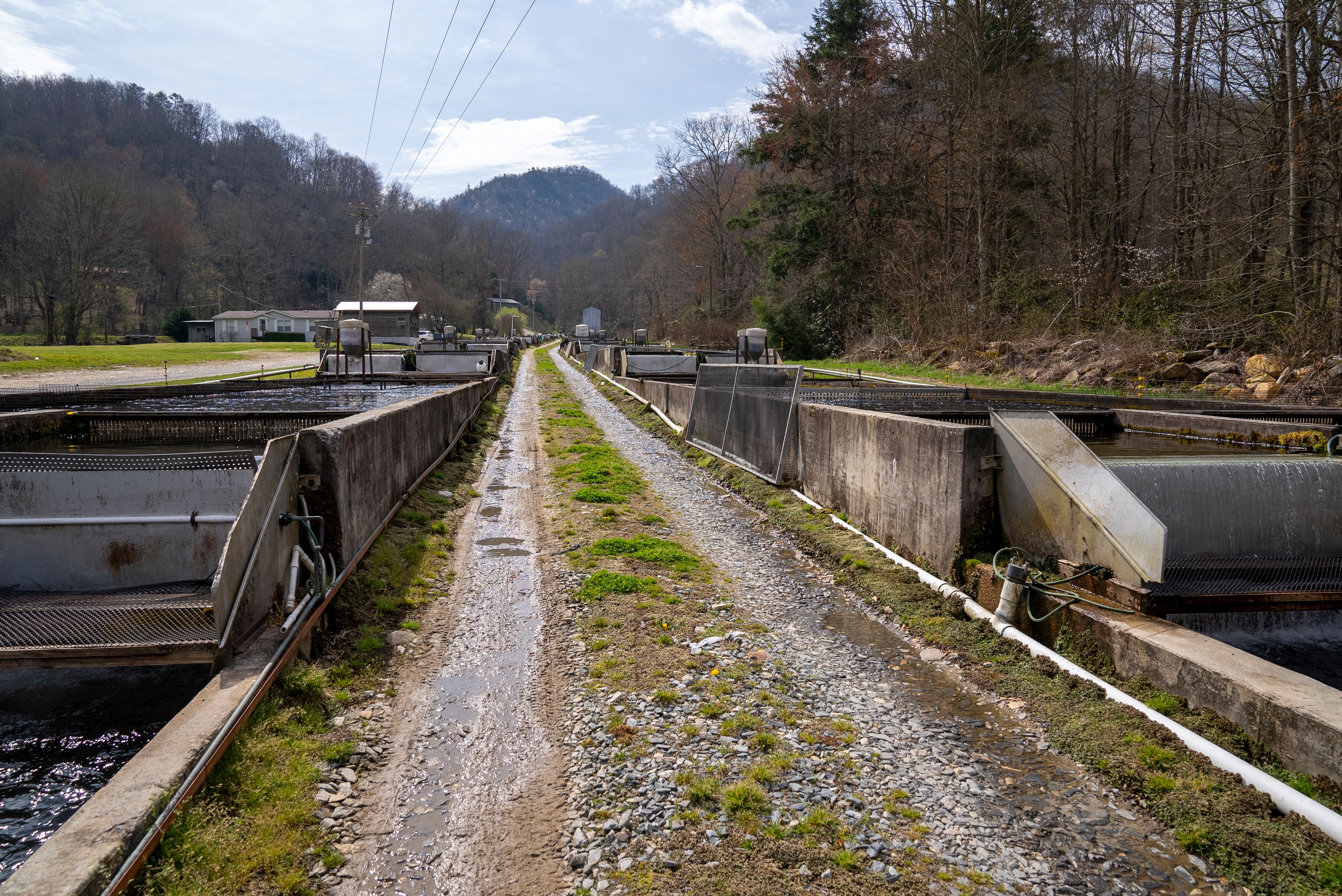
The directed current carries away faeces and feed fines, mixes the water and gives many species a swimming stimulus. Oxygen is partly supplied by the incoming flow, but at higher density and feed load that is rarely enough on its own: modern raceways are often supplemented with pure oxygen (cone, LHO), diffusers or surface aeration. Raceways are among the earliest forms of intensive land-based farming and are still used where there is a stable supply of clean water from springs, rivers, lakes or wells.

Use in Europe and the Nordics
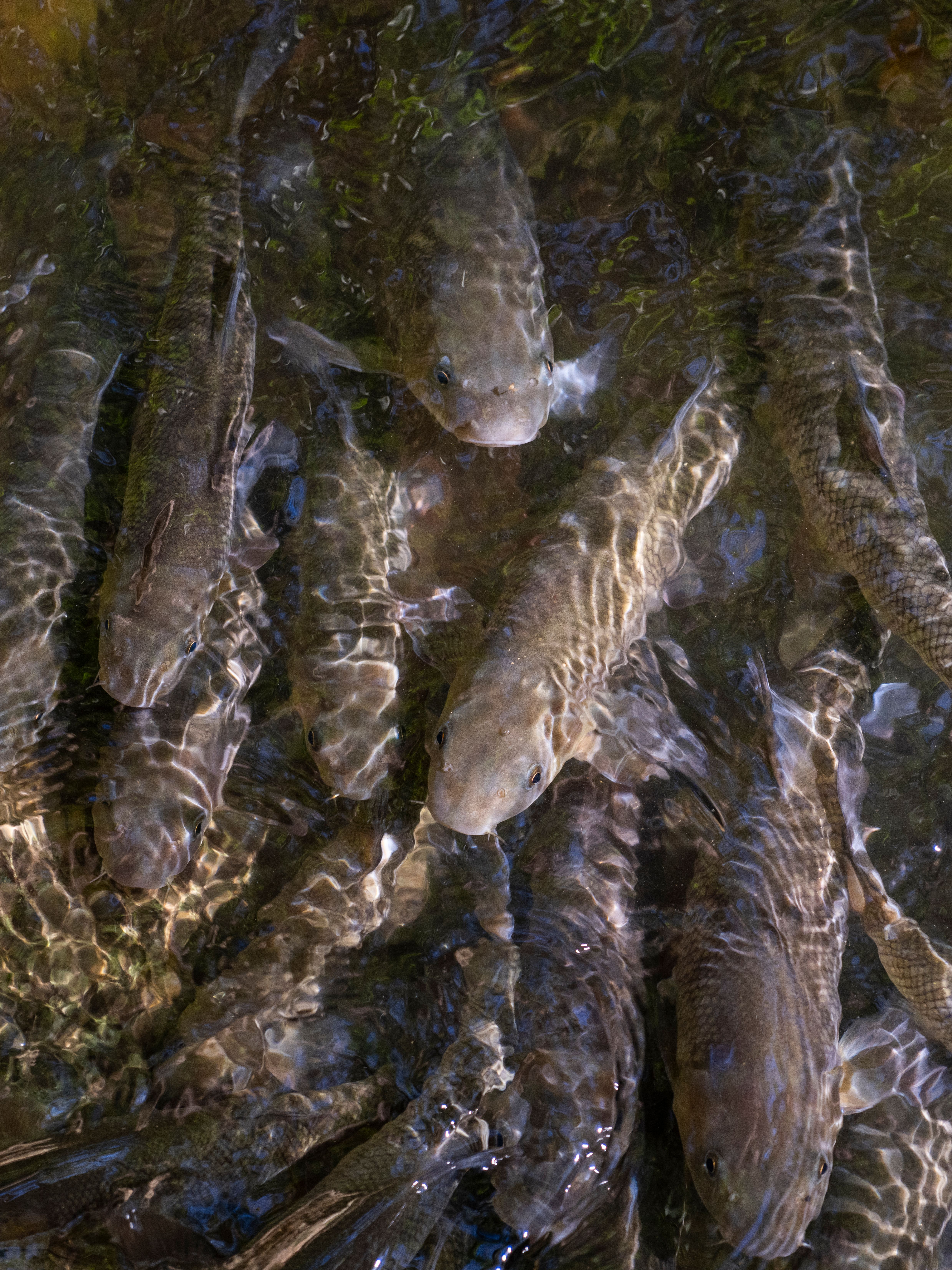
In Europe, classic raceways are mainly linked to cold-water salmonids and related culture: rainbow trout, brown trout, salmon smolt, Arctic char and to some extent whitefish (Coregonus). Sturgeon for meat and caviar is also grown in channels or raceway-like units on some sites. Many Nordic hatcheries and smolt facilities use the raceway principle in parts of the chain - often together with troughs, circular tanks and more closed steps - thanks to simple handling, good overview and proven hydraulics.
Global use
Internationally the spectrum is wider. In North America, raceways still dominate much of rainbow trout and hatchery salmonid production. In warmer regions, channels and raceway-like units are used among other things for carp, tilapia and African catfish (Clarias), where the focus is often simple operation, low CAPEX and high volume rather than "natural" current simulation for salmonids.
Some marine and specialty species (e.g. European sea bass, gilthead seabream, eel, barramundi) are sometimes grown in long tanks or channels that resemble raceways, but often with different materials, salinities and flow regimes. Abalone and some other invertebrates have their own raceway-style systems - related in geometry, not the same as a classic freshwater trout raceway. The point is that "raceway" describes a hydraulic form more than a single species list.
Why do raceways work?
Species such as salmon, brown trout, rainbow trout and Arctic char are adapted to flowing water. Raceways mimic parts of that hydraulics: directed flow, swimming stimulus and quick transport of solids toward the outlet. Continuous swimming can support condition and more even growth - provided density, flow and oxygen are sized correctly. For robust species such as carp, catfish and tilapia, the raceway form is more a practical production unit with easy harvest and overview than a "natural river habitat".
Design and operation in brief
Sizing starts from biomass, feed load, species oxygen demand and the water quality you need along the channel - especially dissolved oxygen and solids at the outlet. Pure flow-through is driven mainly by flow; the higher the density, the more critical flow, oxygen addition and solids removal become. Water rights, source quality and receiving-water permits set the outer frame - see also the flow-through section.
- Series vs parallel: series raceways save space/flow but worsen water quality and raise pathogen risk downstream; parallel gives more equal units.
- Gravity and head: natural head cuts energy cost; pumping raises OPEX and operational dependence.
- Hydraulics: even cross-section flow reduces dead zones; screens, stop-boards and emergency outlets are standard.
- Solids and discharge: settling, microscreen or other treatment before the receiver is often required under modern permits.
- Handling: grading, harvest and daily checks are easy in channels - a practical advantage in hatchery and grow-out.
- Biosecurity: intake protection, zoning, dedicated equipment and controlled egg/fish intake limit pathogens - critical because the system is more open than full RAS.
Advantages
- Simple, proven technology with low complexity compared with full RAS.
- Good hydraulics: solids transport, mixing and swimming stimulus for many salmonids.
- Easy monitoring, grading and harvest.
- Lower CAPEX and simpler operation than tightly controlled closed loops, where source and receiver allow.
- High production capacity when flow, temperature and oxygen are stable.
Limitations
- High freshwater use in pure flow-through; capacity is limited by available flow.
- Source quality (temperature, turbidity, pathogens, upstream impacts) hits the farm directly.
- Nutrients and organic matter must fit discharge permits and the receiving water's capacity.
- Lower biosecurity than closed land-based systems if intake and pathogen control are weak.
- Exposure to seasonal swings, drought, heat, ice runs and sudden water-quality changes.
- Oxygen risk at peak feed if flow and oxygen addition are undersized - flow alone is not a guarantee.
Raceways as a bridge to semi-flow and RAS
Historically, raceways were a central part of early intensive land-based farming, alongside ponds and hatcheries. Today they often act as an intermediate form: the same channel geometry can sit in pure flow-through or be linked to treatment and partial reuse.
Many modern facilities use a chain where raceway volume is combined with process-water treatment:
Raceway (culture unit)
↓
Mechanical filtration
↓
Biofilter
↓
Oxygenation / degassing
↓
Partially returned water
+ make-up from source
(partial reuse / hybrid-RAS)
Such partial-reuse or hybrid solutions keep the handling simplicity of the raceway unit while cutting freshwater need and discharge load versus pure flow-through - without requiring the extreme reuse rate of full RAS.
Raceways can therefore be seen as a historical and practical step between pond culture and more closed systems: full RAS on one side, and semi-flow-through / partial reuse (e.g. DABCE FlowFarm) on the other - where FlowFarm is a buildable semi-flow concept rather than full recirculation.
Design considerations - raceways in a larger puzzle
From an optimisation and engineering perspective, raceways are rarely "the whole answer". They are one piece among several culture units and process steps. A well designed farm often combines different units in a chain where each step matches life stage, risk, cost and site conditions - rather than forcing all production into a single tank form.
Typical building blocks that can be mixed in the same project or value chain:
- Small tanks and troughs - hatchery, first feed, quarantine, high control and biosecurity.
- Raceways - juveniles and grow-out where flow, swimming stimulus and easy handling pay off.
- Circular or octagonal tanks - RAS and semi-flow with even hydraulics and compact footprint.
- Ponds - low CAPEX and volume in suitable climates, often lower density.
- Cages in lake or sea - large grow-out volume when environment, permits and logistics allow.
- Water treatment and gas balance - filters, biofilters, oxygen, degassing, UV/ozone linking the units.
When several units and life stages sit in the same facility or value chain, flow and biosecurity design become critical. The ideal is to separate water flows between zones - e.g. hatchery/quarantine, juveniles and grow-out - so that a pathogen is not carried "backwards" in the chain via shared return water, common sumps or uncontrolled reuse. Where full hydraulic separation is not practical (shared source, partial reuse, same receiving water), carefully sized bio-barriers are needed at critical points instead: solids removal before disinfection, then e.g. UV and/or ozone (often in series), sometimes with residual-ozone handling, on make-up, transfer water or between zones. A barrier is only as strong as its weakest link - turbid water, wrong UV dose, bypass or shared equipment undermines the effect.
Example chains: hatchery in small tanks → raceway or semi-flow on land → finish in cages; or pond-based start in warmer climates → intensification in channels; or a fully land-based chain with raceways in flow-through where the source is strong, and more closed steps where water or discharge is the bottleneck. Optimal design depends on species, life stage, water supply and temperature, receiving water and permits, energy and labour, market and logistics, and risk profile (disease, escapes, storms, ice).
The point is to assign the right unit to the right step - and to see the farm as an engineering puzzle where raceways, small tanks, ponds, cages and treatment can be combined into a whole that fits the site. There is rarely a universal "best" raceway farm; there are solutions that are proportionate to local conditions.
See also Flow-Through Systems (water rights, receiving water, FlowFarm model), RAS, hybrid systems, ponds, net pens, and the sections on oxygen, solids and biosecurity.