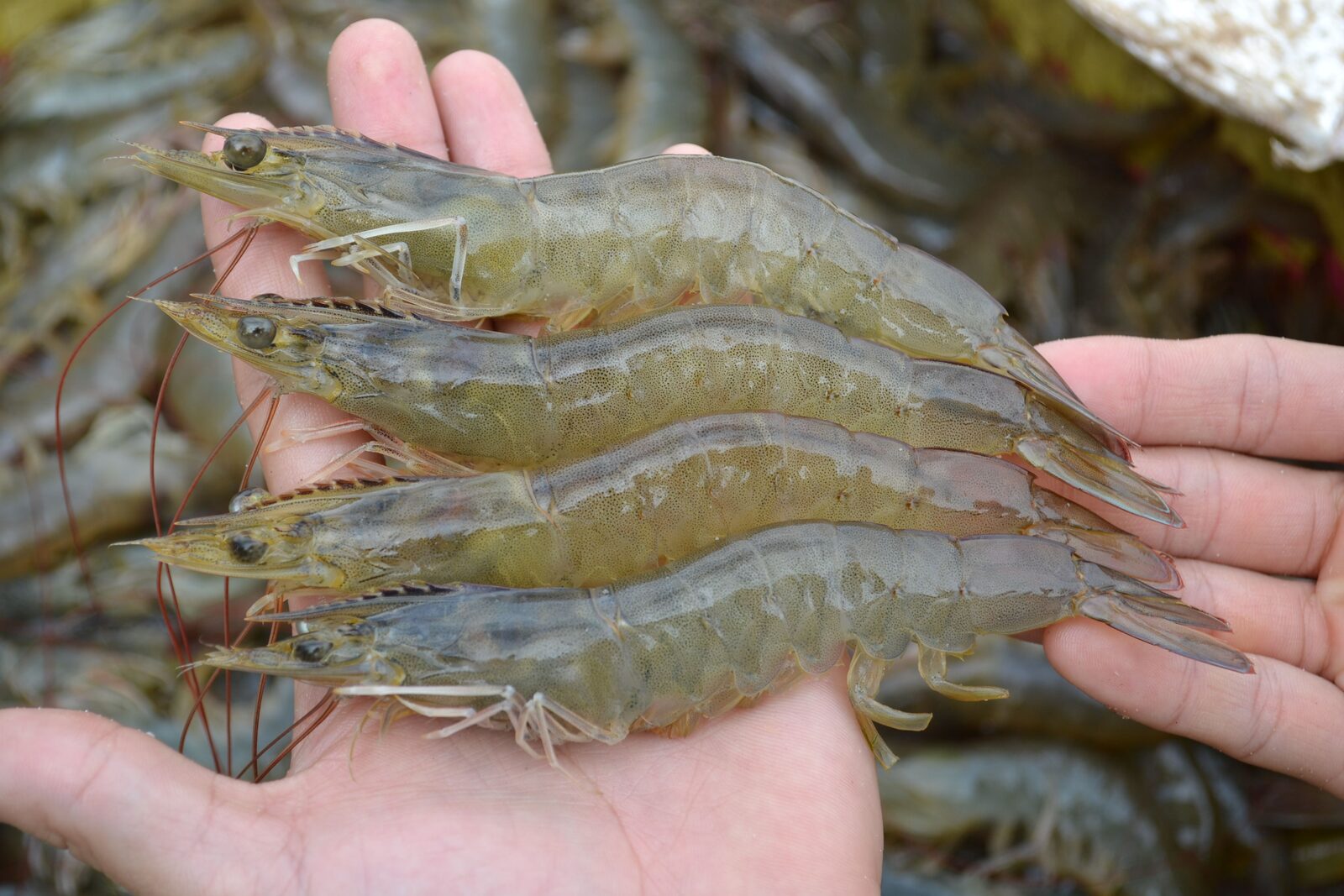
Shrimp (Litopenaeus spp., Penaeus spp. and other farmed shrimp) is the world’s largest aquaculture product by trade value and one of the most important protein sources from aquaculture globally. The dominant farmed species is whiteleg shrimp (Litopenaeus vannamei), which accounts for most of international production. Traditionally shrimp are farmed in earthen ponds and coastal systems in tropical regions, but in recent years intensive biofloc culture and land-based recirculating systems (RAS) have gained commercial interest.
Land-based shrimp farms offer high biosecurity, reduced pathogen spread and the chance to produce fresh premium shrimp near consumer markets in Europe and North America. Technology has made it possible to farm tropical shrimp even in cold climates, but energy costs for heating and water treatment remain an important challenge.
Main farmed species
| Species | Comment |
|---|---|
| Whiteleg shrimp (Litopenaeus vannamei) | The world’s most important farmed shrimp. Fast-growing, hardy and relatively adaptable to different salinities. |
| Black tiger shrimp (Penaeus monodon) | Larger species, often premium. High market recognition but generally somewhat slower growth and higher demands than vannamei. |
| Giant river prawn (Macrobrachium rosenbergii) | Farmed mainly in tropical freshwater systems. Large sizes and a different production setup than marine penaeids. |
The production sizer below is mainly oriented toward L. vannamei grow-out.
Temperature
Shrimp are poikilothermic and growth is strongly driven by water temperature. Temperature control is one of the main cost factors in land-based production in northern Europe.
| Parameter (L. vannamei) | Typical range |
|---|---|
| Optimal | 27–32 °C |
| Acceptable | 24–34 °C |
| Growth declines | Below about 24 °C |
| Mortality risk | Prolonged below about 20 °C |
Orientation — strain, stage and oxygen affect real tolerance.
Salinity and mineral balance
A major advantage of L. vannamei is its euryhaline nature: the species can be farmed across a wide salinity range. Optimal salinity often sits around 10–30 ppt; culture can go toward nearly freshwater and also full seawater (~35 ppt). At low salinities ion balance becomes critical — sodium, potassium, calcium and magnesium for osmoregulation, shell formation and growth. Many low-salt systems therefore need mineral supplementation.
Oxygen demand
- Desired DO: >5 mg/L.
- Critical level: <3 mg/L.
- Biofloc systems often need very strong aeration.
- Oxygen shortage quickly causes stress, reduced growth and higher disease sensitivity.
Biofloc technology (BFT)
Biofloc technology is one of the main innovations in modern shrimp farming. Adding a carbon source (e.g. molasses or starch) stimulates bacterial growth that converts ammonium into microbial biomass. Small flocs (biofloc) are kept suspended by intensive aeration and can be grazed by the shrimp.
- Advantages: lower water exchange, lower ammonia, natural protein supplement, high productivity per volume.
- Disadvantages: high aeration energy, complex operation, risk of oxygen swings, high particle load.
Biofloc is used across much of the tropical shrimp industry and is often seen as an alternative or complement to classic RAS technology.
RAS for shrimp culture
Recirculating systems enable production with very low water intake and high biosecurity. Typical components: culture tanks, solids filtration, biological treatment, CO₂ stripping, UV or ozone, oxygenation and temperature control. Advantages are especially large where land, water or biosecurity limit traditional pond culture. See also fry tanks for differences between fish and shrimp tanks (bottom area, substrate, moulting).
Biomass density
| System | Typical density |
|---|---|
| Extensive pond | 0,5–2 kg/m³ |
| Intensive pond | 2–10 kg/m³ |
| Biofloc | 10–30+ kg/m³ |
| Modern RAS | 15–50+ kg/m³ |
Maximum density is often limited by oxygen, biofilter and organic-matter handling. Orientation.
Feed and FCR
- High-protein pellets, typically about 30–40% protein.
- FCR often about 1.1–1.8.
- Feed cost often exceeds 50% of production cost.
- Automated feeding and camera systems are increasingly used to cut waste.
Growth and production cycle
Under optimal conditions L. vannamei can reach market size in a relatively short time. Growth is strongly affected by temperature, feed quality, genetics and water quality.
| From postlarva | Typical time |
|---|---|
| To about 20 g | 3–4 månader |
| To about 30 g | 4–5 månader |
| To about 40 g | 5–6 månader |
Orientation under good temperature. The production sizer counts from stocking (PL/juvenile) to harvest.
Disease and biosecurity
Historically disease has been the largest economic risk in shrimp production. Important examples: White Spot Syndrome Virus (WSSV), EMS/AHPND (Early Mortality Syndrome), IMNV (Infectious Myonecrosis Virus) and EHP (Enterocytozoon hepatopenaei). Many modern RAS projects exist specifically to reduce that risk through controlled water supply and strict biosecurity.
Economics and market
Demand is global — from low-cost production in tropical ponds to premium segments with locally produced fresh shrimp. Drivers for European RAS production include shorter supply chains, higher freshness, reduced antibiotic use, better traceability and lower environmental impact. Despite higher production costs, locally produced premium shrimp can often sell at substantially higher prices than imported frozen products.
Key sizing parameters
- Production (t/year), harvest weight (g), biomass density (kg/m³).
- Feeding (kg/day), FCR, temperature, salinity.
- DO, TAN, nitrite, nitrate, alkalinity and pH.
- Aeration and oxygen capacity; heat demand and energy use.
For land-based shrimp farms, temperature control, oxygenation and biofilter capacity are normally the three most important sizing factors.
Production sizer (pond / biofloc / RAS)
The production sizer estimates numbers, standing biomass and culture volume from target production, harvest weight, cycle time, survival and density (kg/m³). Pick a system preset for typical densities and cycle times (L. vannamei-oriented). Orientation for concept development — not bankable facility design.
Production sizer: shrimp / L. vannamei (orientation)
 © 2026 DABCE AB
See also
- Temperature
- Salinity
- Dissolved oxygen
- RAS
- Ponds
- Fry and larval tanks
- Biosecurity
- Feed types
- Mineral and ion management
Sources/overview (selection): FAO and industry statistics on Litopenaeus vannamei / Penaeus monodon; biofloc literature (e.g. Avnimelech); RAS and biosecurity overviews for land-based shrimp; WSSV/AHPND/EHP reviews. Density, cycle time and FCR are orientation — strain, temperature, salinity and health govern real production.