
Introduction
A private well is a water source that belongs to the property, not to a municipal network. The owner is responsible for the water that comes out of the tap: quality, quantity, pumps, treatment and upkeep.
Well water can be excellent. It can also change with the seasons, with nearby land use, and with how the well was built. This page is a practical guide for homeowners, plumbers and anyone who commissions or maintains a private supply.
What a private well is
Most household wells draw groundwater — water that has soaked through soil and rock into an aquifer. Some properties use a dug well, a drilled borehole, a spring, or a shallow intake that is closer to surface water than it first appears.
The important distinction is not the name on the invoice. It is this:
- A well-protected borehole takes water from a deeper, more stable layer.
- A shallow well, poorly sealed well or spring is more easily reached by rain, meltwater, surface water and activity on the ground above.
Treatment, sampling and risk all follow from that difference.
What well water often contains
Groundwater is shaped by the ground it has passed through. Typical parameters on a well analysis:
- pH, alkalinity and hardness
- Iron and manganese
- Turbidity and colour (particles, humus)
- Conductivity and chloride
- Nitrate
- Bacteria (E. coli and coliforms)
- Sometimes radon, fluoride, arsenic or other local substances
- In coastal or winter-salt areas: salt and brackish influence
Clear water is not the same as safe water. Iron can be invisible until it meets air. Bacteria have no taste. Low pH can run for years before the first blue-green stain appears.
A water analysis is the starting point for every serious decision: drinkability, treatment choice and pipe materials.
Related: Water Analysis, Groundwater, Low pH Water, High pH Water, and iron and manganese.
Commissioning a new well — or a well you have just taken over
Commissioning means: prove that the well can supply the property, and that the water is fit for the intended use, before everyone starts living on it as if it were a city main.
1. Know what was built
Ask for or record:
- Type of well (drilled, dug, driven, spring collection)
- Depth, casing, screen or open hole
- How the top is sealed (cap, apron, cables, vents)
- Distance to sewage, animals, fuel, compost, ditches and the house drain
- Pump type, depth of intake, pressure tank and existing treatment
A well without a proper cap and surface seal is an open invitation to insects, frogs, meltwater and dirty splash from the yard.
2. Clean start
After drilling, flooding, pump work or a long standstill:
- Flush the well and the pipework thoroughly
- Disinfect the well and the indoor installation if that is local good practice after construction or contamination
- Change or clean filters that filled with drilling debris or rust
- Do not judge taste or colour on the first tank of water
3. First analyses
Take a proper sample when the well has been pumped and the water is representative — not only a glass from a tap that has not been used for a week, and not only water taken while the driller is still flushing cuttings.
As a minimum for a household well: bacteria, pH, conductivity, hardness, iron, manganese, nitrate, and whatever is known to occur locally (radon, fluoride, arsenic, chloride). If the house has copper or old solder, include metals on a first-draw sample after the system has sat unused.
4. Yield and pressure
A beautiful analysis is useless if the well cannot keep up in July.
- Note the sustainable yield, or at least how the level drops during a normal household peak
- Size the pump and pressure tank to the well, not only to the number of taps
- A well that sands or draws air needs a mechanical look before a treatment catalogue is opened
5. Treatment only after the numbers
Install treatment for the water you actually have. A calcite tank, an iron filter or a UV unit each answers a different question. Guesswork creates the next problem (pH too high, blocked media, UV behind dirty water).
Commissioning is finished when: the well is sealed, the pump is stable, a representative analysis exists, and any treatment is chosen from that analysis.
How a well should sit in the ground
Good protection is cheaper than good treatment.
- The casing should stand above the surrounding ground so rain runs away, not in
- A sanitary seal at the surface stops short-circuit flow down the outside of the pipe
- Keep distance from sewage infiltration, stables, slurry, heating oil, pesticides and the driveway drain
- Do not use the well pit as a storage box
- Electric cables and drop pipes should pass through a proper cap, not a gap beside a loose lid
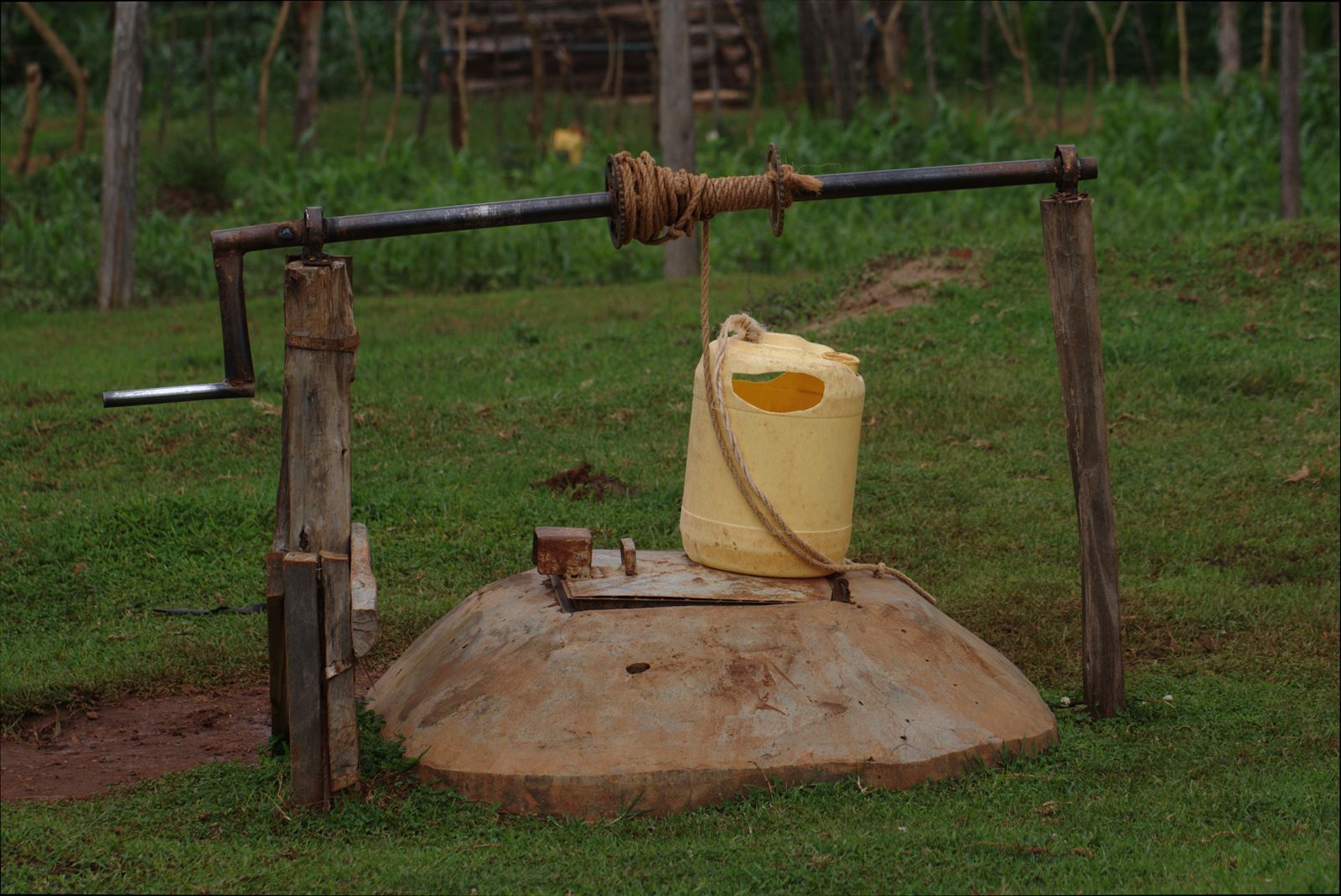
If dirty water can run down the annulus or through a cracked lid, the aquifer never gets a fair chance.
Related: Groundwater Protection.
Seasonal changes
Well water is not a bottled product. It moves with weather, groundwater level and use.
Spring and snowmelt
Higher water table. Shallow wells and poor seals see more surface influence: turbidity, colour, bacteria, sometimes a sudden change in taste. This is the classic season for “the water was fine in February”.
Summer and dry periods
Levels fall. The pump may run longer. A well that was stable can begin to draw from a different layer, pull in sand, or take a larger share of a nearby ditch or lake. Iron and manganese sometimes rise. Yield complaints belong here.
Autumn rains
Similar to spring: recharge, more organic colour in some terrains, more risk of surface water finding a weak wellhead.
Winter
Lower biological activity in the ground, but frozen ground can change how melt and slush sit around the well cap. Indoor plumbing still sees the same chemistry — pH and metals do not take the season off.
After a flood or a flooded well pit
Treat it as contamination until proven otherwise. Do not drink it on the basis of “it looks clear again”. Flush, inspect the cap and seal, disinfect if appropriate, and sample for bacteria before normal use.
A well that changes colour only after heavy rain is telling you it is in contact with surface water. That is a construction and protection issue, not only a filter issue.
Surface-water intrusion
Surface water is rain, melt, ditch water, lake water and anything that has not been filtered by a long path through the ground.
When it enters a well you often see:
- Sudden turbidity or yellow-brown colour after rain
- Positive coliform or E. coli results
- Taste and smell that come and go
- Debris, insects or snails in the well or pump
- A well level that jumps with the ditch or the lake beside it
This is not the same as ordinary groundwater with iron. Iron can be treated. Repeated bacterial ingress means the well is open to the surface. UV or chlorination can be a necessary barrier, but they do not replace a tight cap, a surface seal and enough distance from obvious dirt.
If the source is in practice a lake or a stream, treat it as surface water (particles, organics, microbes, seasonal blooms), not as a deep well.
Related: Lake Water, Groundwater.
Common well-water problems and what usually sits behind them
| What you notice | Often linked to |
|---|---|
| Blue-green stains, metallic taste, pinhole leaks | Low pH, copper plumbing |
| White crust, stiff laundry, scaled heater | Hardness, sometimes higher pH |
| Brown, yellow or rusty water | Iron, sometimes humus or corroded steel |
| Black specks or black slime | Manganese, or manganese plus bacteria |
| Rotten-egg smell | Hydrogen sulphide |
| Cloudy water after rain | Surface influence, poor seal, shallow well |
| Stomach-bug concern, bad bacteria result | Surface intrusion, sewage near the well, no cap |
| Salty taste near the coast or winter roads | Chloride, brackish water, salt intrusion |
Match treatment to the cause. An iron filter will not fix a missing well cap.
Treatment on a private well — the usual order
There is no single “well filter”. There is a chain, built from the analysis.
A common household order:
- Protect the wellhead (always)
- Particle removal if the water is cloudy
- pH correction if the water is acidic (before iron removal)
- Aeration / oxidation if iron, manganese or hydrogen sulphide need air or ozone
- Iron and manganese filtration
- Softening if hardness is a real problem for the house
- Carbon if taste, smell or certain organics require it
- UV or another disinfection barrier when microbes are a risk
- Optional kitchen RO for drinking water only
UV needs clear water. Put it last among the dirt-removing stages, not first.
Related pages in this knowledge centre cover low pH and high pH, iron and manganese, UV, ozone, reverse osmosis and disinfection in more detail.
Example chains
Well
↓
Pressure tank
↓
Calcite neutraliser
↓
House
Sample bacteria at commissioning and after any well work.
Well
↓
pH correction if needed
↓
Aeration or ozone
↓
Iron/manganese filter
↓
UV
↓
House
Cap, seal, drainage and distance from surface water
↓
Filtration
↓
Disinfection
If rain still arrives in the well, the well itself is the problem.
Analysis over time. Treatment options depend on how salty it is — from “live with it and protect pipes” to specialised desalting. See Brackish Water and Seawater.
Living with a private well
A well is closer to a small waterworks than to a tap on a city main.
Useful habits:
- Sample regularly, not only when something looks wrong. After floods, pump changes or a long empty house, sample again.
- Keep the area around the well clean and graded so water runs away.
- Service pumps, pressure tanks and treatment media on a calendar, not only when someone complains.
- Note seasonal changes in a simple log: colour after rain, falling yield in summer, smell in autumn.
- Do not dispose of oil, pesticides or washing water near the well.
- If you add a treatment stage, measure after it — including pH at a far tap.
Private wells and other water types
- Groundwater is the normal well source when the well is properly built.
- Lake water and other surface sources need a different particle and microbe design.
- Brackish water and seawater are salinity problems first.
- Pool and spa water are circulating, dosed systems — not raw well water, even if the fill tap is the well.
The well can feed all of these. Each use still needs its own quality target.
Important to remember
A private well is only as good as its construction, its seal and the care it receives. Analysis tells you what is in the water. The wellhead tells you what can still get in tomorrow. Seasonal change is normal; surface water in the well after rain is a warning.
Commission the well, protect it, measure it, then treat what the numbers show.
This page is general guidance for homeowners, plumbers and property managers. It is not a design for a specific well. Local rules and a site analysis decide the final solution.